Enveriti is an operational platform for private credit funds. A single patented identifier threads every facility from origination through audit — across every lifecycle event, every computation, and every evidence package. Built on a 6-Step Canton Narrative, the platform replaces manual reconstruction with deterministic, cryptographically-proven truth.
ScrollWhen a private credit fund originates a loan, that loan moves through dozens of operational processes. Today, each of those processes lives in a separate system or spreadsheet, and fund controllers spend nearly a third of every month reconciling them by hand.
Enveriti replaces that patchwork. The platform threads one patented identifier across up to five parties — the fund manager, the agent, the administrator, the borrower, and the servicer — from the moment a facility is created through every interest calculation, every journal entry, every attestation, and every audit evidence package. The computations are deterministic and reproducible. The results carry cryptographic proof and are immediate — eliminating the operational silos that force month-end reconstruction.
The result is one version of chronologically established truth. Every number ties out, or it fails. Three patent-pending inventions — spanning system architecture, computational methodology, and identifier design — make this possible.
Fund controllers spend nearly a third of every month manually reconstructing the same evidence across disconnected systems. The infrastructure that connects origination to audit was never built.
A facility originates in one system, lives in another, settles in a third, and reports from a fourth. No persistent identifier threads the full lifecycle, so reconciliation is manual and error-prone.
Interest income, carrying values, and amortization schedules are computed in spreadsheets with no audit trail. Results cannot be reproduced independently, and materiality testing is often approximated or skipped.
Five or more parties touch the same facility — agent, fund manager, administrator, servicer, and auditor. Each maintains their own record. There is no shared, attested source of truth.
Filed February 2026 under Track One Priority Examination.
Deterministic computation of effective interest rates, carrying values, and amortization schedules at the component level. Side-by-side EIR vs. straight-line materiality analysis on every facility — previously a manual reconstruction exercise. Every output reproducible to the penny.
Every computational output is packaged with cryptographically verified evidence codes — daily positions, carrying values, accrued income, journal entries. Each evidence package is independently reproducible and auditable on demand. It ties out or it fails.
Five distinct roles — Operator, Agent, Administrator, Borrower, and Fund Manager — each attest to the same immutable record for every lifecycle event. Multi-party consensus replaces bilateral reconciliation. No single party can misrepresent the state of a facility.
The Evidence Spine is a working system with 180+ operational views across 19 modules, running 30 facilities across 4 funds. Every number is computed deterministically and reconciles to zero variance. Below are six representative views.
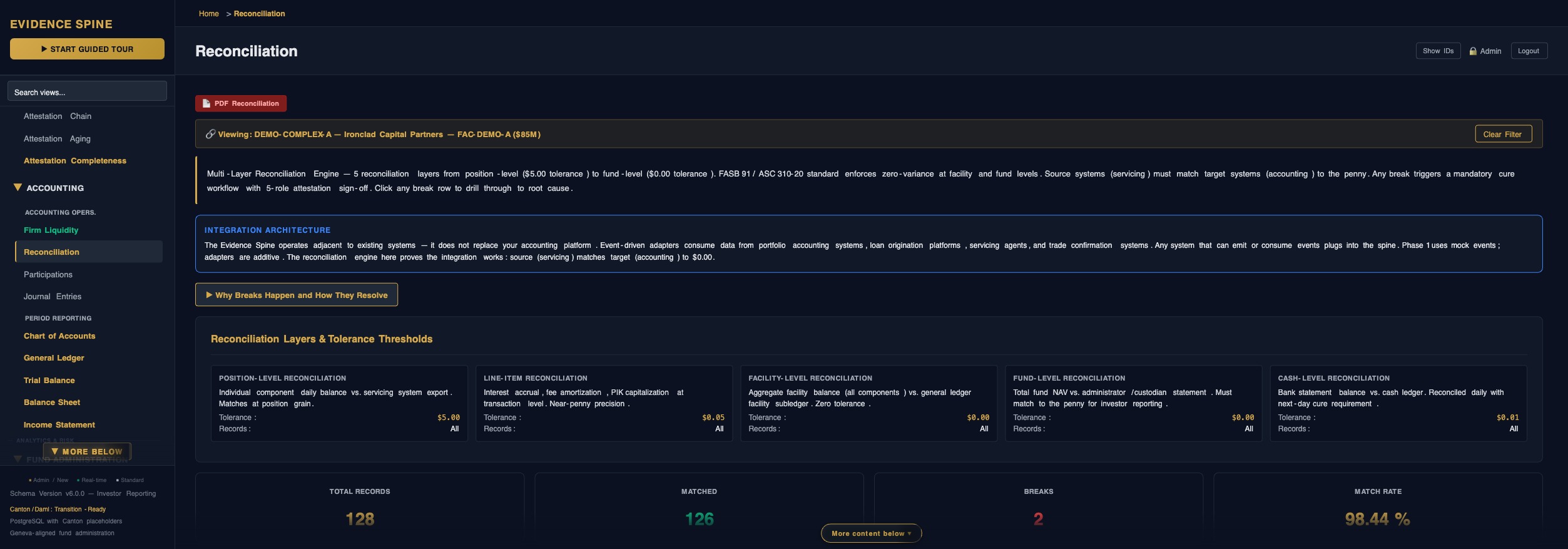
Source systems (servicing) must match target systems (accounting) to the penny. The engine runs five reconciliation layers from position-level ($5.00 tolerance) to fund-level ($0.00 tolerance). Any break triggers a mandatory cure workflow.
Zero-Variance Architecture
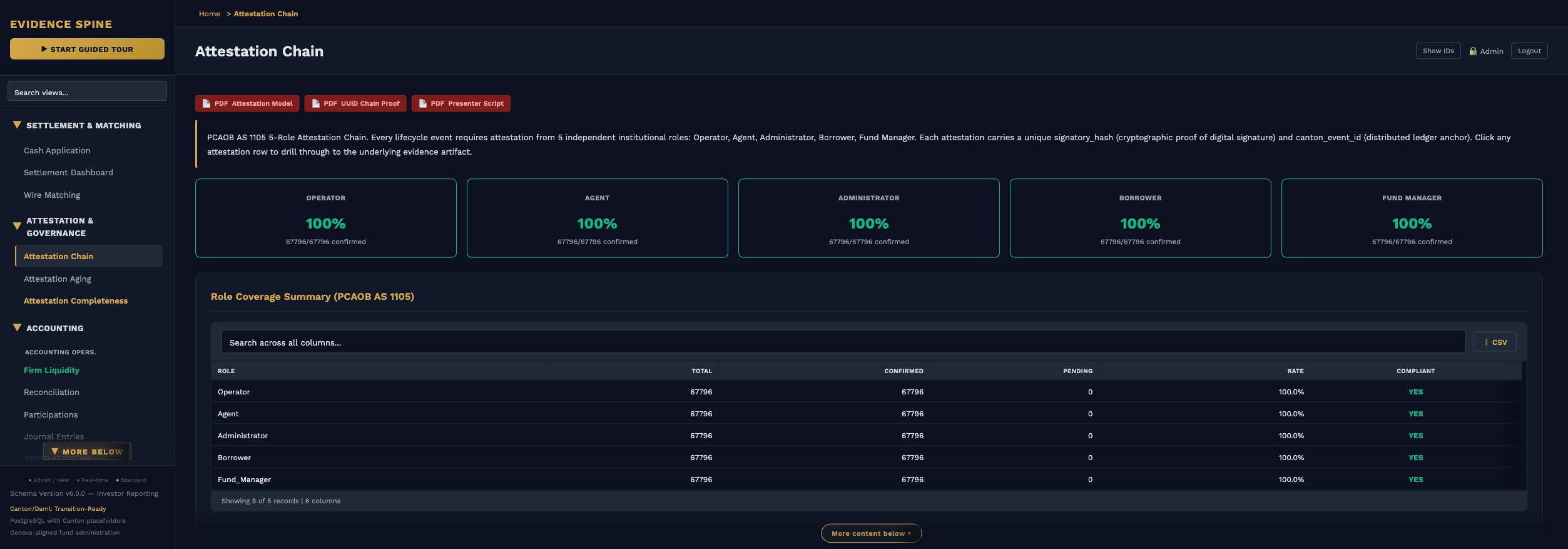
Every material event requires five-role attestation: Operator, Agent, Administrator, Borrower, and Fund Manager. The matrix tracks coverage daily across the full portfolio and flags gaps before they reach audit.
PCAOB AS 1105
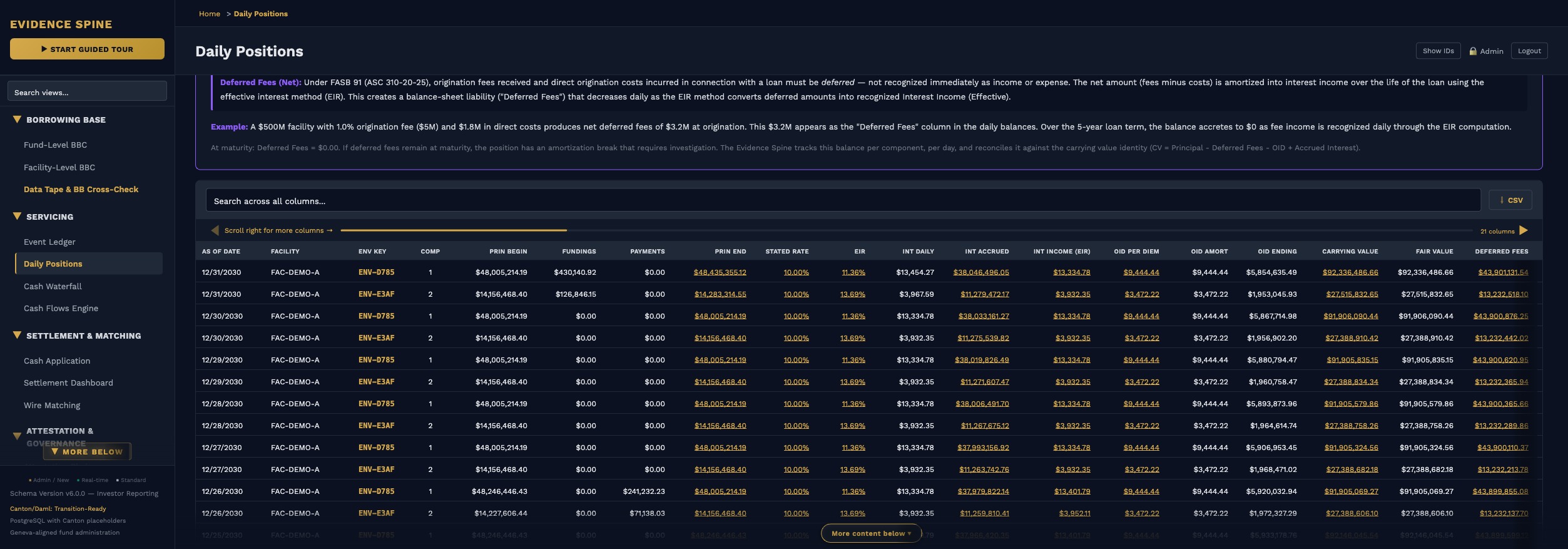
Every facility carries a daily position record: principal balance, carrying value, accrued interest (EIR), OID amortization, and deferred fee accretion. Each row includes a net investment check that must balance to the penny.
FASB 91 / ASC 310-20
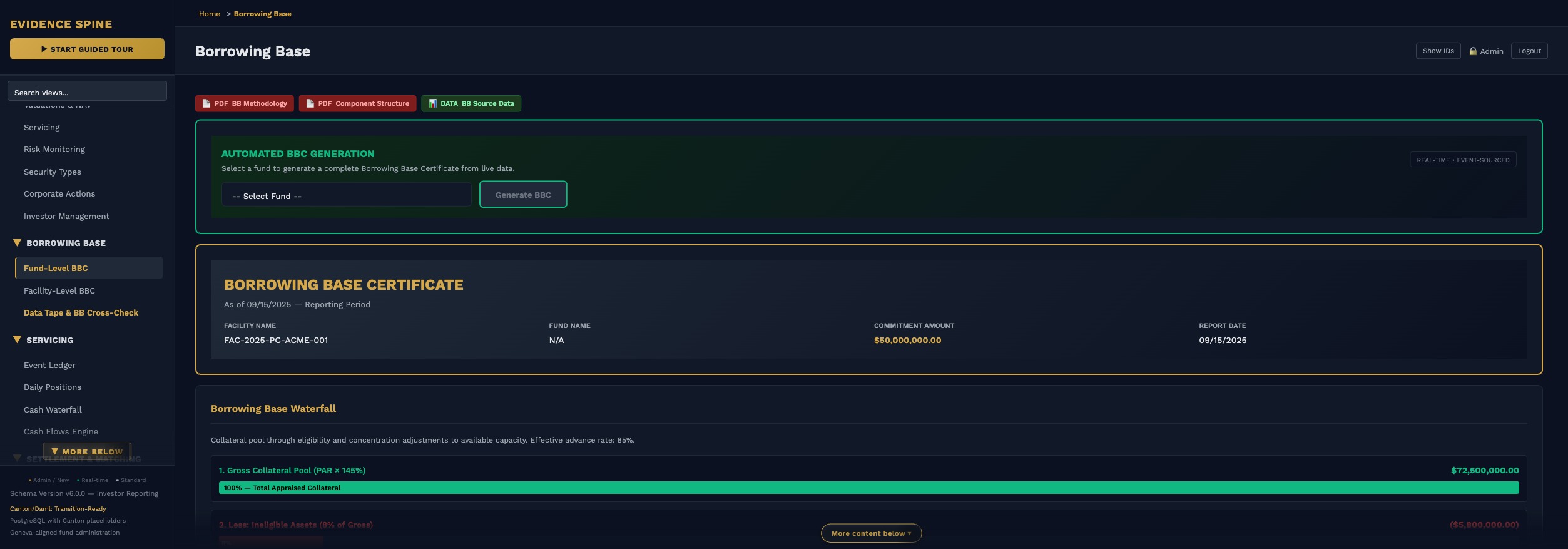
A seven-step waterfall computes the borrowing base from gross eligible assets through ineligible exclusions, concentration limit deductions, advance rate application, and dynamic reserve charges. Utilization and coverage ratios update in real time.
Credit Facility Compliance
Three concurrent accounting bases — Expected (GAAP/FASB 91), Contractual (credit agreement terms), and Legal (default provisions) — all derived from one event stream. Book variances surface instantly for compliance and risk review.
Three Books of Record
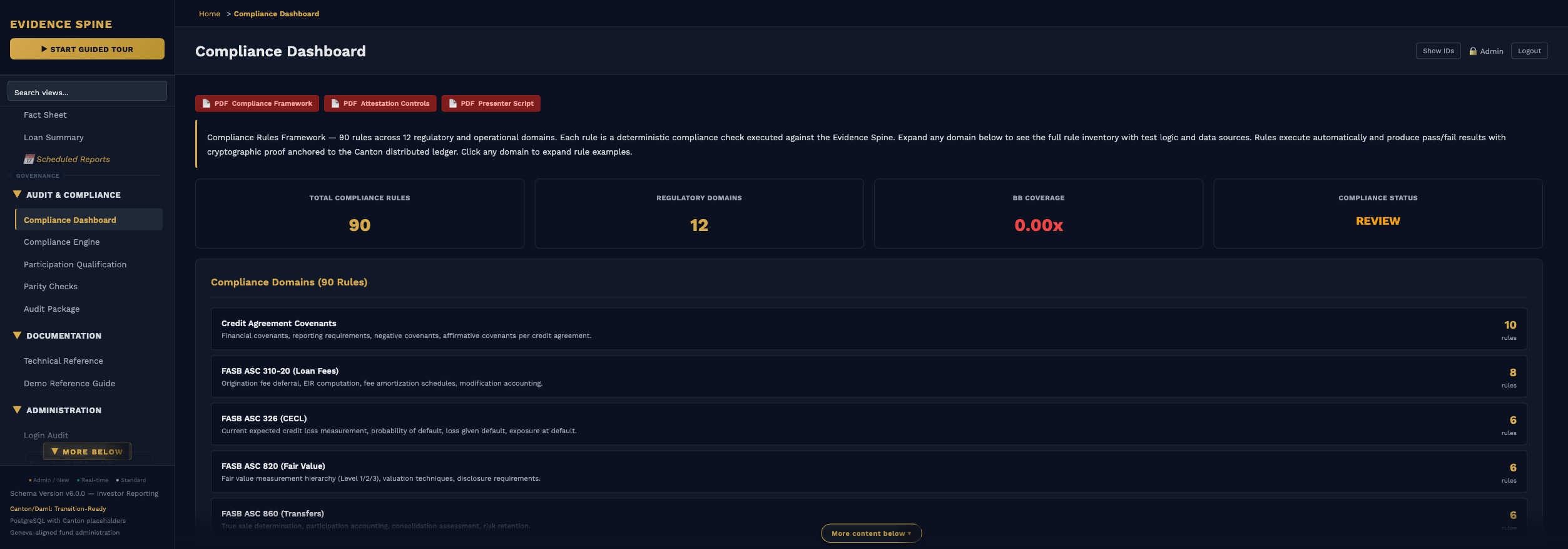
25,000 deterministic rules across 12 regulatory and operational domains, each executing as automated SQL tests or manual attestations with full batch tracking and trending.
12 Regulatory DomainsThe platform embeds accounting and regulatory requirements directly into its computation engine. Each standard is enforced through automated compliance rules that execute on every transaction — not checked retrospectively in a quarterly review.
Every module below is built and working in the platform today. Click any pillar to see the modules inside it.
Every table, event, and attestation in the Evidence Spine carries Canton-ready structural fields — the data model is designed for distributed ledger integration from day one. The architecture is built so that activating Canton ledger transaction IDs and cryptographic signatures from participant nodes is a configuration event, not a rebuild.
Five institutional roles — Operator, Agent, Administrator, Borrower, and Fund Manager — validate the same event through Canton’s privacy-preserving sub-transaction protocol. No bilateral reconciliation needed.
Lifecycle events execute as Daml smart contracts where all parties see the same state simultaneously. The gap between “what happened” and “what was recorded” disappears.
Every Canton transaction produces a cryptographic proof anchored to the Global Synchronization Domain. Auditors verify the ledger directly rather than sampling.
The current platform runs on FastAPI with PostgreSQL — a high-performance async Python framework purpose-built for deterministic computation at scale. Canton-ready fields are native to every table. Moving to production Canton is a backend swap — all downstream views, reconciliations, GL entries, and reports work identically because the data contract (UUIDs, hashes, 5-role attestation) is already in place.
25+ years of institutional finance and operations distilled into infrastructure that proves every dollar, every computation, every attestation.